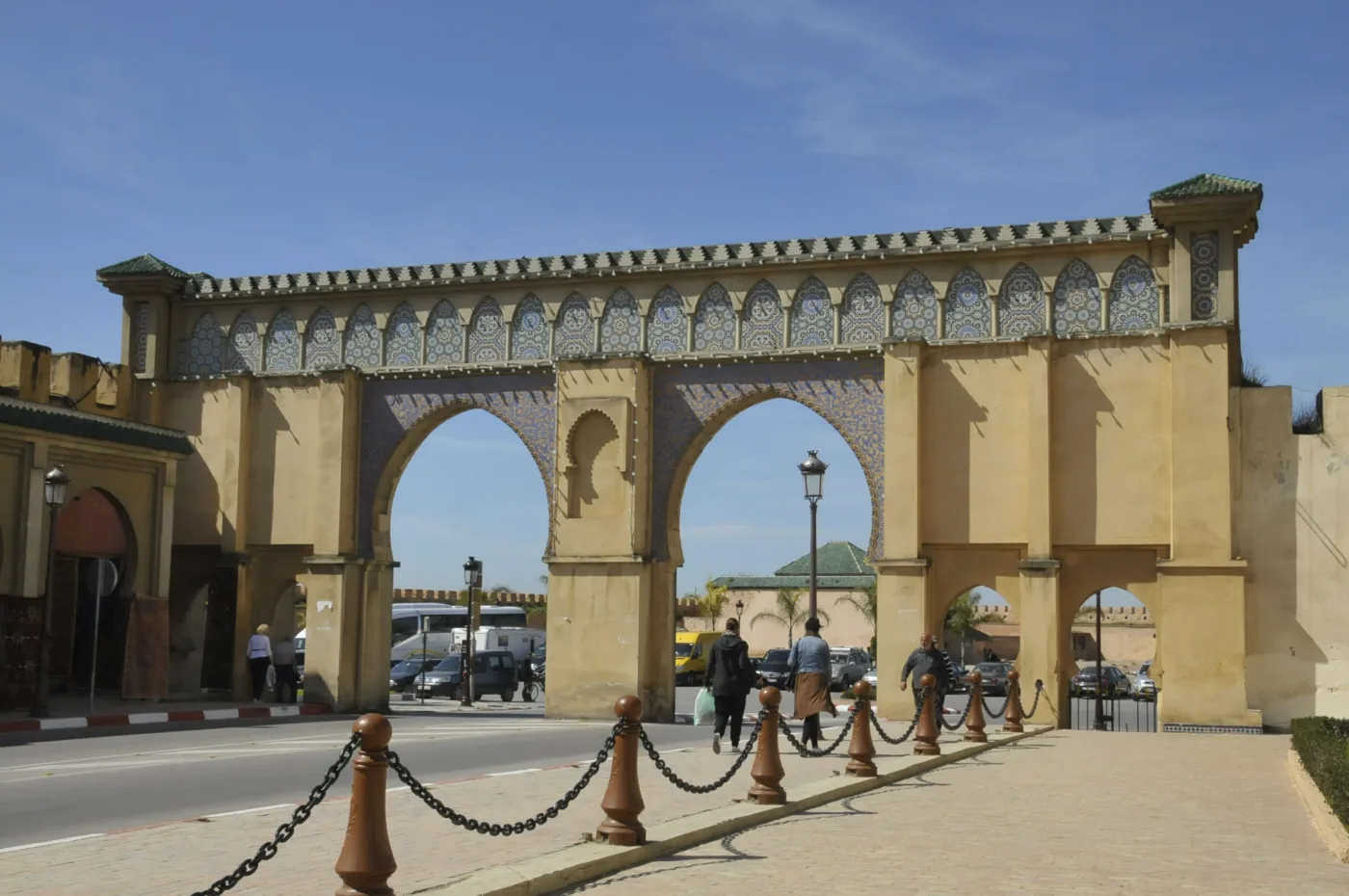

<p>If you have half a day in Meknes, give it a centre: El Hedim square. From there you can look across to Bab Mansour, visit the Dar Jamaï music museum and take a short walk into the old city. Seeing these places together helps explain the different roles of the square, the imperial gate and the house that became a museum. It also gives your group a clear place to meet if some people want to linger.</p> <h2>Start in El Hedim square</h2> <p>Ask your driver or guide to name a pickup point at the edge of the square. “At the gate” can be ambiguous when you’re standing in an old city with several gates. Pick a landmark you can find again, and keep a map pin and the driver’s number handy. Before setting off, look across the square to see how its open space contrasts with the narrow lanes you’ll encounter in the medina.</p> <h2>Look at Bab Mansour from two distances</h2> <p>Start far enough back to see the full façade. Look for the large central arch, then see how the smaller decorative fields are arranged around it. Move closer only where the crossing and pedestrian space allow. You’ll notice detail in the tilework and how the decoration changes across the surface. <a href="https://whc.unesco.org/en/list/793/">UNESCO’s account of historic Meknes</a> gives the wider context: the city became an imperial capital under Moulay Ismaïl, and monumental gates help explain the scale of that project.</p> <p>Plan on seeing the gate from the outside. If works or barriers limit your view, take in what you can from the square and continue to Dar Jamaï. Keep your meeting point separate from the spot where you plan to take photographs; a convenient angle is rarely also a convenient place for a vehicle to stop.</p> <h2>Give Dar Jamaï its own time</h2> <p>The <a href="https://www.fnm.ma/museums/37">Dar Jamaï National Museum of Music</a> is housed in a former private residence. The Fondation Nationale des Musées describes displays of Moroccan instruments organised by how they produce sound. Start by comparing two instruments: what vibrates when each is played, and what would the player do with their hands? Then look at the building itself, including its decorated surfaces and garden where accessible. You can enjoy the museum even if you arrive knowing very little about Moroccan music.</p> <p>The museum lists Tuesday as its usual closure day. Check its official page before going, especially around holidays. Ask about steps and current room access if anyone in your party needs a shorter or gentler route. If the museum is closed, spend your time between the square, the gate and a short medina loop rather than chasing an interior you haven’t confirmed.</p> <h2>Should you combine Meknes and Volubilis?</h2> <p>It can work if you choose what matters most. Put the stop with the tighter timing first and leave room for lunch and the drive between them. If your main interest is the music museum, give it a proper visit instead of treating Meknes as a photo stop. If the ruins are your priority, read our <a href="/blog/volubilis-from-fes-planning">Volubilis planning guide</a> and keep Meknes to the square and gateway. Tell <a href="/#booking">MLV</a> which stop you would rather keep if the day needs to be shortened.</p>
Meknes in Half a Day: El Hedim, Bab Mansour and Dar Jamaï
Build a short Meknes visit around one square, an imperial gateway and a museum of Moroccan music, with time to look closely at each.