

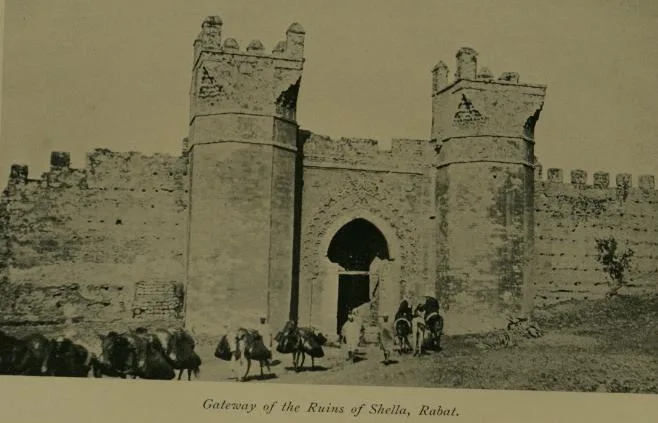
<p>Chellah is easy to mistake for a single set of ruins. Walk through its monumental gateway and you’re entering a site where a medieval Marinid necropolis occupies part of the earlier city of Sala. The most rewarding visit is one that gives those layers room to make sense. Look at the gate before you go in: the archival cover photograph, published in 1910, gives you a comparison for the arch and the two flanking towers you’ll see on arrival.</p>
<h2>Start with the gate and a map</h2> <p>Once inside, ask which sections are open and where the visitor route returns to the entrance. Use the site map or ask at the desk to identify the remains of Sala and the medieval enclosure. Some of the ancient walls are low enough that you may walk past them while looking toward the taller structures. If you have only a short visit, pick one labelled stop in each period instead of trying every path.</p>
<h2>Look for the plan of Roman Sala</h2> <p>The <a href="https://www.chellah.site/en/visit-chellah/the-site/">Chellah site guide</a> identifies the ancient city as Sala Colonia. For a first visit, look at the ground plan: follow a stretch of wall with your eyes and ask where a person would have entered the space. A small break may be clearer from one side of a path than the other. Read the sign before assigning a purpose to a wall or room. The low remains tell you more when you can picture people moving through them.</p>
<h2>Then look at the Marinid enclosure</h2> <p>The medieval complex has a different purpose: it includes a royal burial site. Pay attention to how the walls frame the space and look for traces of the mosque and its minaret. The contrast with the earlier city is the point of visiting both areas. If you’re visiting with children, try asking which remains show a boundary, a doorway or a place meant for gathering, then compare your guesses with the signs.</p>
<h2>Choose a visit that fits your pace</h2> <p>The operator’s <a href="https://www.chellah.site/informations-pratiques/">visitor information</a> lists basic admission, an audio guide option and an accompanied visit by reservation. Check the page for current admission and hours; opening times change with the season and Ramadan. If an audio guide is central to the visit, ask which languages are available before buying. If you’re already booking a city guide, confirm whether that person will accompany you inside and whether admission is included.</p> <p>For anyone using a cane, walker or wheelchair, ask about the open route on your date, including gradients, steps and surfaces between the gate and each set of ruins. The operator warns that some areas may remain inaccessible for conservation reasons. A shorter visit can still work well: see the gateway, choose one reachable viewpoint or interpretive stop, and agree on a pickup point before entering.</p> <p>If Chellah is one stop on a city day, read our <a href="/blog/rabat-day-trip-from-casablanca">Rabat day trip guide</a> before choosing what to pair it with. Give the site enough time to read a few labels and look up from the map. That’s usually what makes the two periods stick.</p>